The Terroir
Champagne is the northern limit of serious viticulture — chalk subsoils, cool light and a marginal climate that together shape a style found nowhere else.
Download the reference sheet (PDF · 1 page)Geology
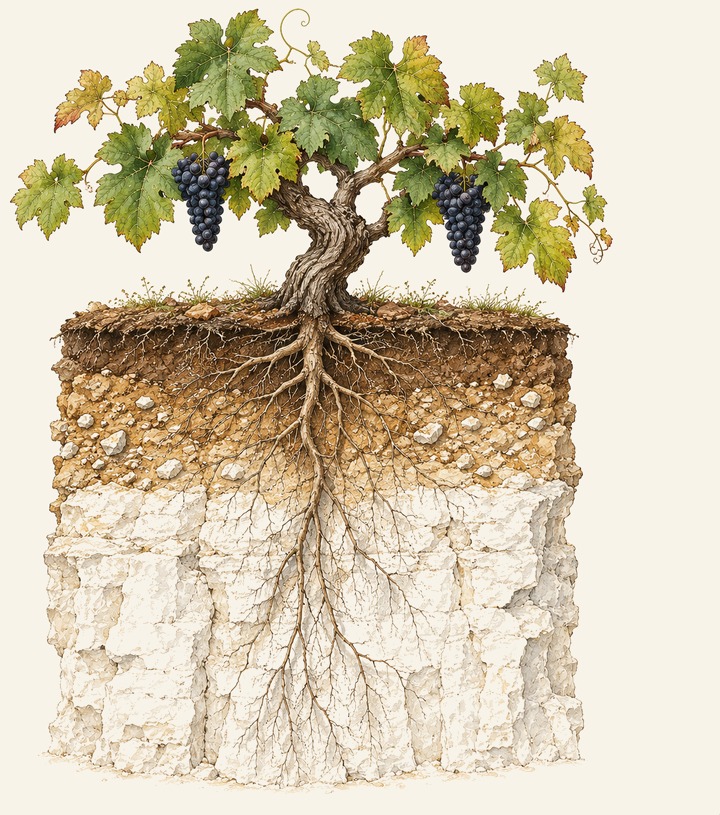
Chalk beneath the vines and cellars
Champagne’s cellars descend straight into what was once a seabed, with vines growing above. Ninety million years ago, a warm, shallow sea lay here, where microscopic shells called coccoliths accumulated, billions to the handful. Compressed together, they formed chalk hundreds of meters deep. The sea withdrew long before the vines came, but its memory lingers in every taut, saline glass of Champagne.

Soils
Water retention takes five forms
The wine reflects Champagne’s varied surface soils because they determine both the amount of water available to each vine and how much effort the vine must make to reach it.
 ChalkA rich chalk foundation serves as both a sponge and a thermostat — it drinks in the rain, defends against the drought, and steadies the rootstock. It creates Côte des Blancs at its purest.
 MarlsThe clay-limestone marls hold both moisture and the day's warmth, releasing each back to the vine as it is needed — they are the backbone of the Côte des Bar, where pinot noir turns broad and generous.
 Hard limestoneHarder limestone is stingier with its water but generous with reflected light, so the vines must work for everything — and the wines from these sites tend to come in tighter and more precise.
 SandSandy pockets drain quickly and warm early in the season, and the wines they produce are suppler and ready sooner than their neighbors.
 Heavy clayWhere the clay runs heavy the soil banks water and nutrients in reserve, and the wines that come off it are rounder, broader, and more generous in their youth.
Landscape
How slopes shape the vineyards
Slopes. With an average slope of 12%, the vineyards benefit in two ways: excess rain can drain away, and the low northern sun reaches the tilted ground at a more direct angle.
Aspect. For each measured lieu-dit, the atlas gives elevation, slope and aspect, reflecting how much orientation matters: south- and east-facing slopes receive morning sunshine and are the first to ripen.
Rivers. On most spring nights, air channelled through the vineyards by the Marne and its tributary valleys drains downhill, carrying frost away before it can cause its greatest damage.
Climate
Two climate influences meet here
Continental. With its continental influence, the region gets summers with enough warmth to ripen grapes, helped by roughly 1,900 hours of annual sunshine. That influence also brings the threat of spring frost, a worry that returns each year for every grower.
Oceanic. Air arriving from the Atlantic gives the climate its oceanic influence, bringing steady rainfall and moderating temperature changes. Most years, conditions stay cool without either scorching heat or severe cold.
The edge. Growing grapes and ripening them for harvest is near its climatic limit at 49°N. These conditions help the fruit retain acidity as it ripens, an essential quality for great sparkling wine. As Champagne warms, its wines change too, because that distinctive acidity is part of what makes them exceptional.
Vineyard Practices
People care for the vines
Three centuries. In these villages, vineyards pass between generations with knowledge gathered over three centuries: the judgment to choose a picking date, decide on a blend and know how much time to allow.
The rules. No vineyard in France is more tightly regulated: written rules govern how much can be harvested, how vines are pruned, which press fractions are used and minimum aging times, with each requirement enforced.
The villages. Throughout this atlas, you will find references to the échelle des crus, the ranking system for these 319 villages, each with a historical standing of its own.
Key Takeaways
Grapes, slopes and people on the map
The atlas locates what this sheet explains: its contours show these slopes, and its grape colors distinguish the noirs in rose from the blancs in gold. The ○ doors mark the people who work on those slopes.
The Chalk Sea · Champagne Atlas © 2026 James Gill, DipWSET · drawn in the spirit of Larmat · thechalksea.com