For the Press
If you are writing about The Chalk Sea, everything you need is on this page — and if it is not, write to me and I will send it. I would far rather answer a question than have you guess.
- What it is
- An atlas of Champagne: 183 villages and 2,502 named vineyards, including the walled clos — with reference sheets, short readings and a tasting curriculum built around it.
- Who made it
- James Gill, in Los Angeles. One person, two years, evenings and holidays. WSET Diploma, and a member of The Golden Vines Academy.
- Where
- thechalksea.com in any browser, and on iPhone and iPad.
- What it costs
- The map is free and always will be. Membership is $39.99 a year, or $29.99 for the first 300 members, who keep that price for as long as they stay.
- Offline
- About 130 MB ships inside the app. Put the phone in Airplane Mode and everything still works except signing in — which matters, because there is no signal in most of Champagne.
- In the atlas
- 183 villages · 2,502 named vineyards · 2,010 spoken pronunciations · 36 vintages, 1988 to 2023
- To read
- 7 reference sheets, 3 of them open to everyone · 13 Bubble Card threads, 89 short episodes · an eight-evening tasting curriculum
- Press contact
- info@thechalksea.com
Why it exists
There is a saying in wine that all roads lead to Burgundy or Champagne. Like learning a language, we grab first at what is easiest to understand, which is usually power — big smells, big flavours, heavy fruit, oak. It is all intoxicating at first. Then at some point many of us come to prefer the small details: a little more acid, a little less alcohol, the more interesting notes that come later.
I ended up at Champagne, as people tend to. And I found that the thing I most wanted to know was the thing hardest to find out: not which bottle scored what, but where it came from — which village, which slope, which patch of chalk, and why that patch should taste different from the one beside it.
That information exists. It is simply scattered across cadastral records, old maps, producer websites in two languages, and the heads of people who live there. So I spent two years putting it in one place, and then I built the thing I had wanted to own.
The thing I would most like written down
Champagne is the most remarkable value in the entire world of wine, and almost nobody believes me when I say it. A $30 to $50 non-vintage bottle from a good grower, laid down for another three or four years, will do something very few wines anywhere can manage at that price. Many are extraordinary.
The reason people do not know this is that Champagne is sold as a luxury and bought as a ritual — once a year, at midnight, from a shelf of forty gold labels that all look the same. The atlas is an argument against that, made with maps instead of adjectives.
Lines you are welcome to quote
All of these are mine and you may use them without asking.
- “Champagne is not one place. It is several hundred villages on very different ground, and the chalk underneath them changes what grows there.”
- “I wanted to know where a wine came from, and found that the answer was scattered across a dozen places and nobody’s head in particular.”
- “The most expensive bottle in the shop is rarely the best bottle for your evening. It is the one with the most history behind the label.”
- “Turn the bottle around. The back label tells you who made it, where, and how sweet it is — and those three facts will serve you better than any score out of a hundred.”
About James Gill
One line. James Gill is a WSET Diploma holder in Los Angeles who spent two years mapping the vineyards of Champagne in his spare time.
Three lines. James Gill got obsessed with Champagne and did something about it. Over two years of evenings and holidays he built The Chalk Sea — an atlas of 183 villages and 2,502 named vineyards, down to the walled clos — and took the WSET Diploma along the way. He is a member of The Golden Vines Academy. He has visited Champagne repeatedly with his wife and children, mostly in the rain.
Screenshots
Seven views, shot on iPad and iPhone from the shipping build. Click any image for the full-resolution file. Use them freely — a credit to The Chalk Sea is welcome and a link is better.
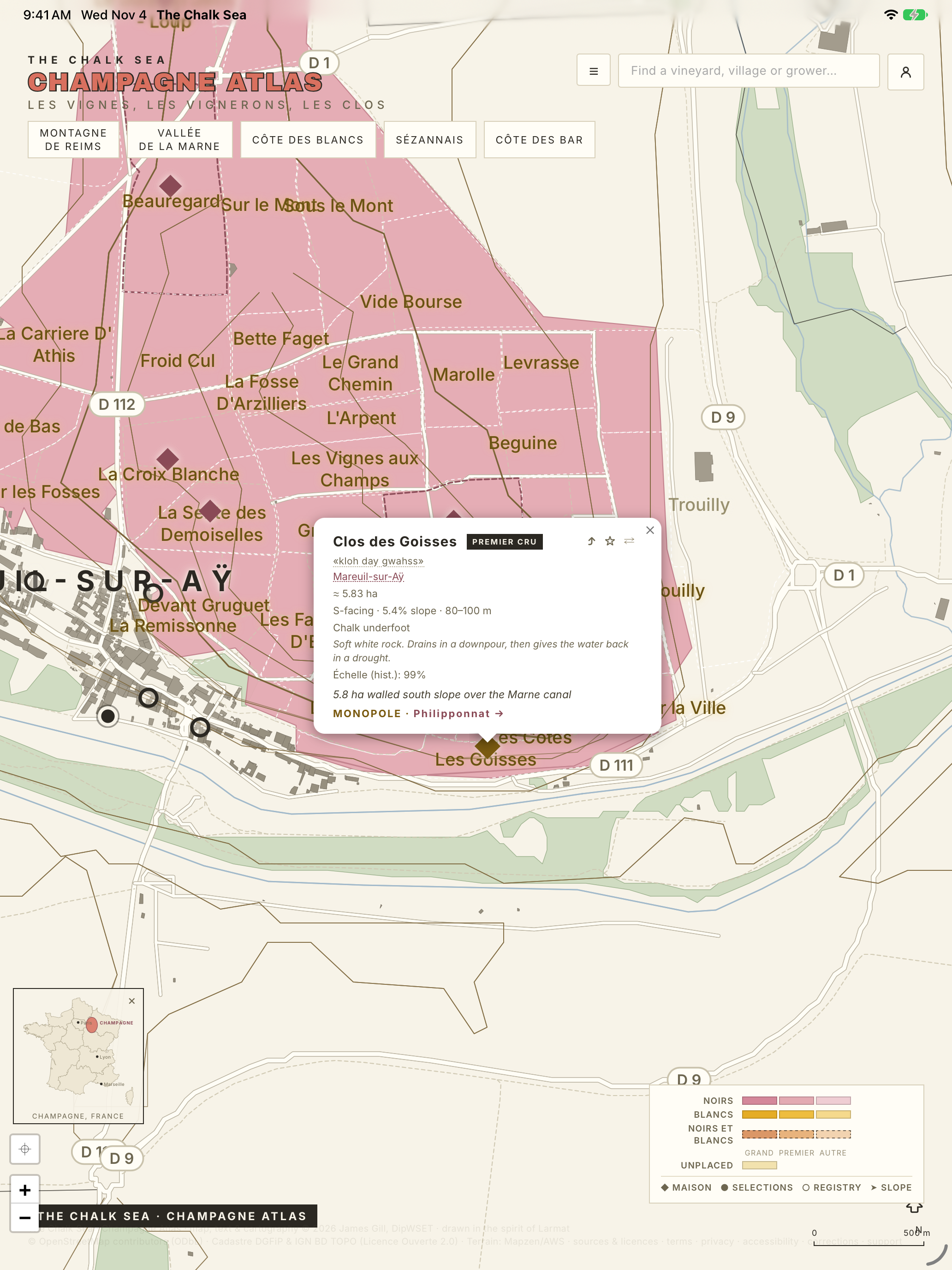
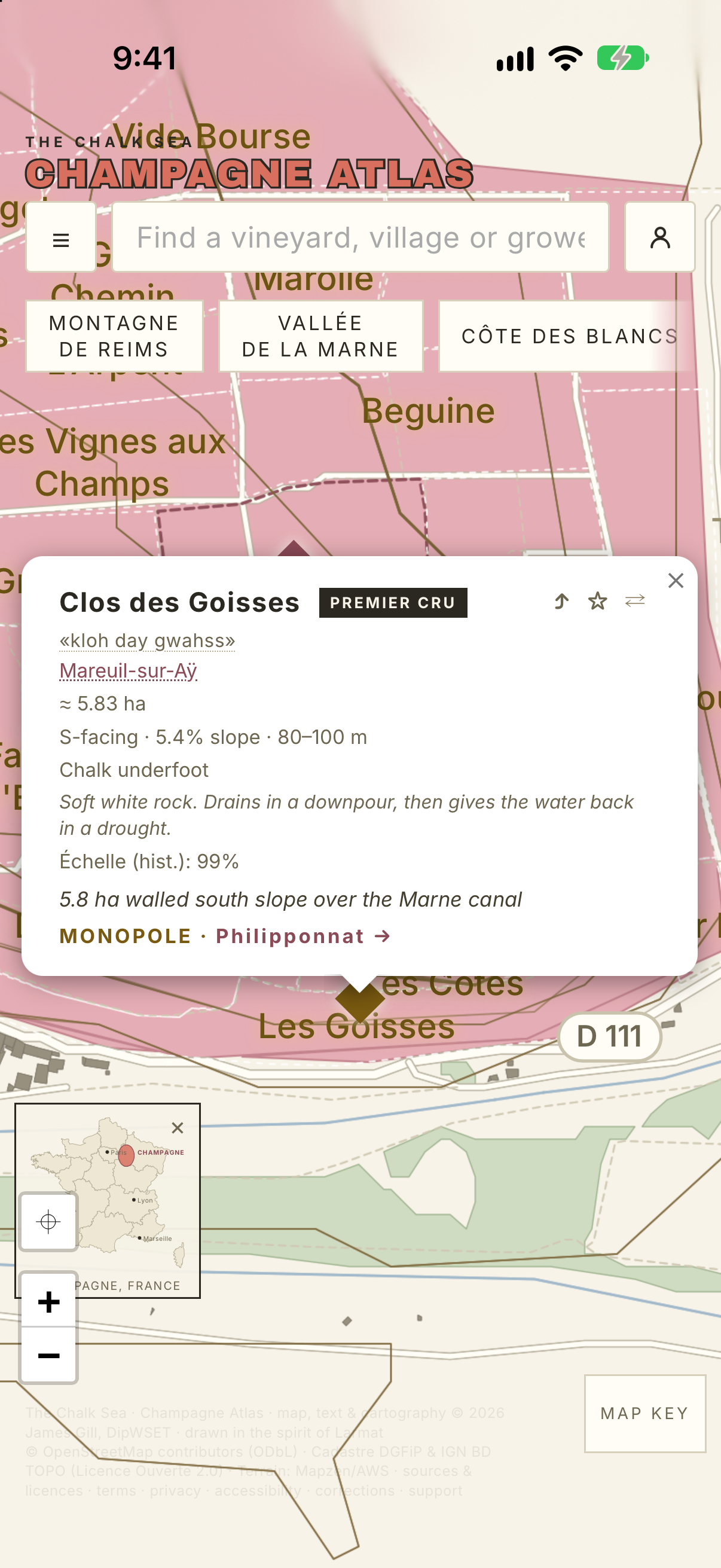
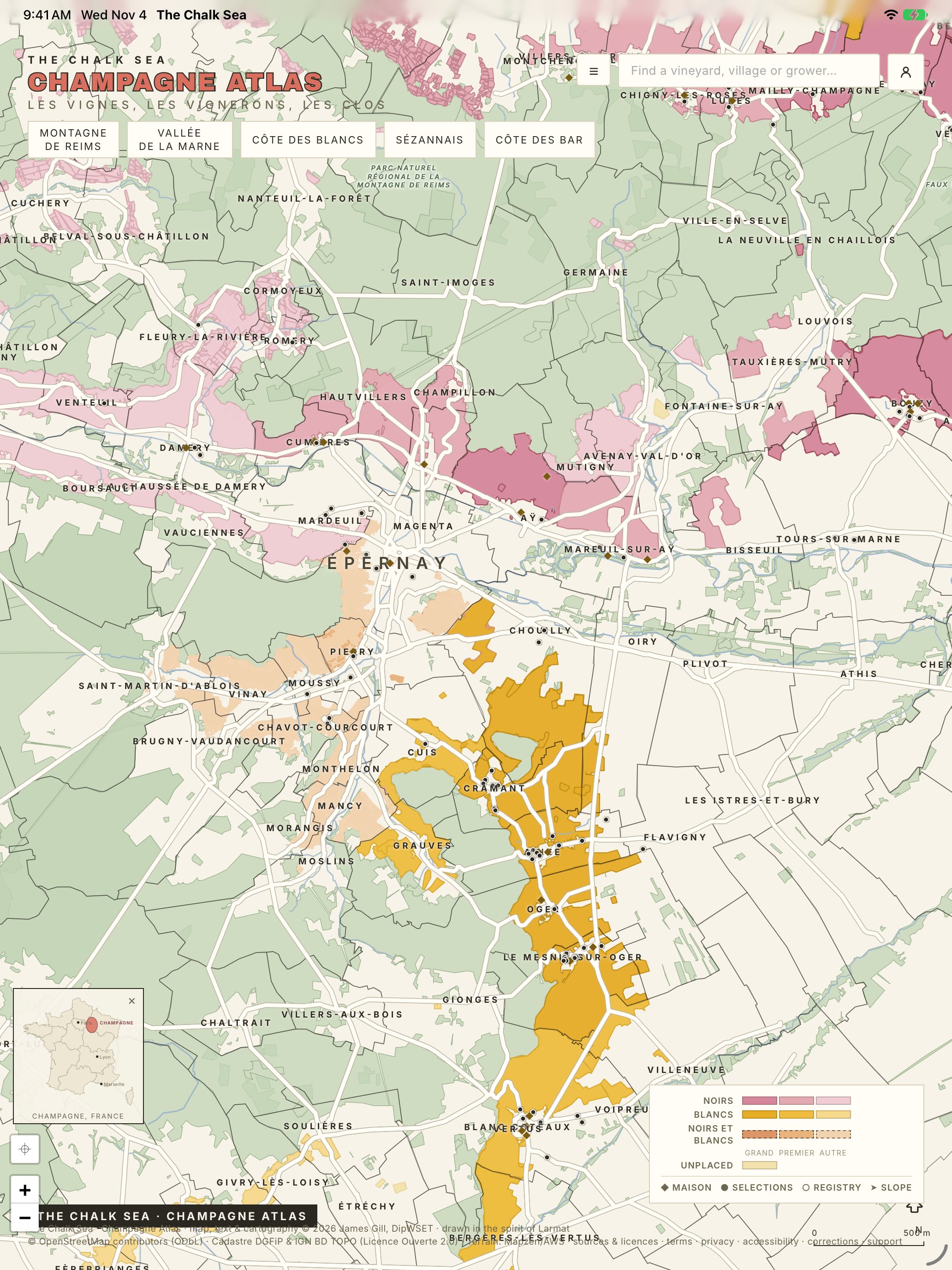
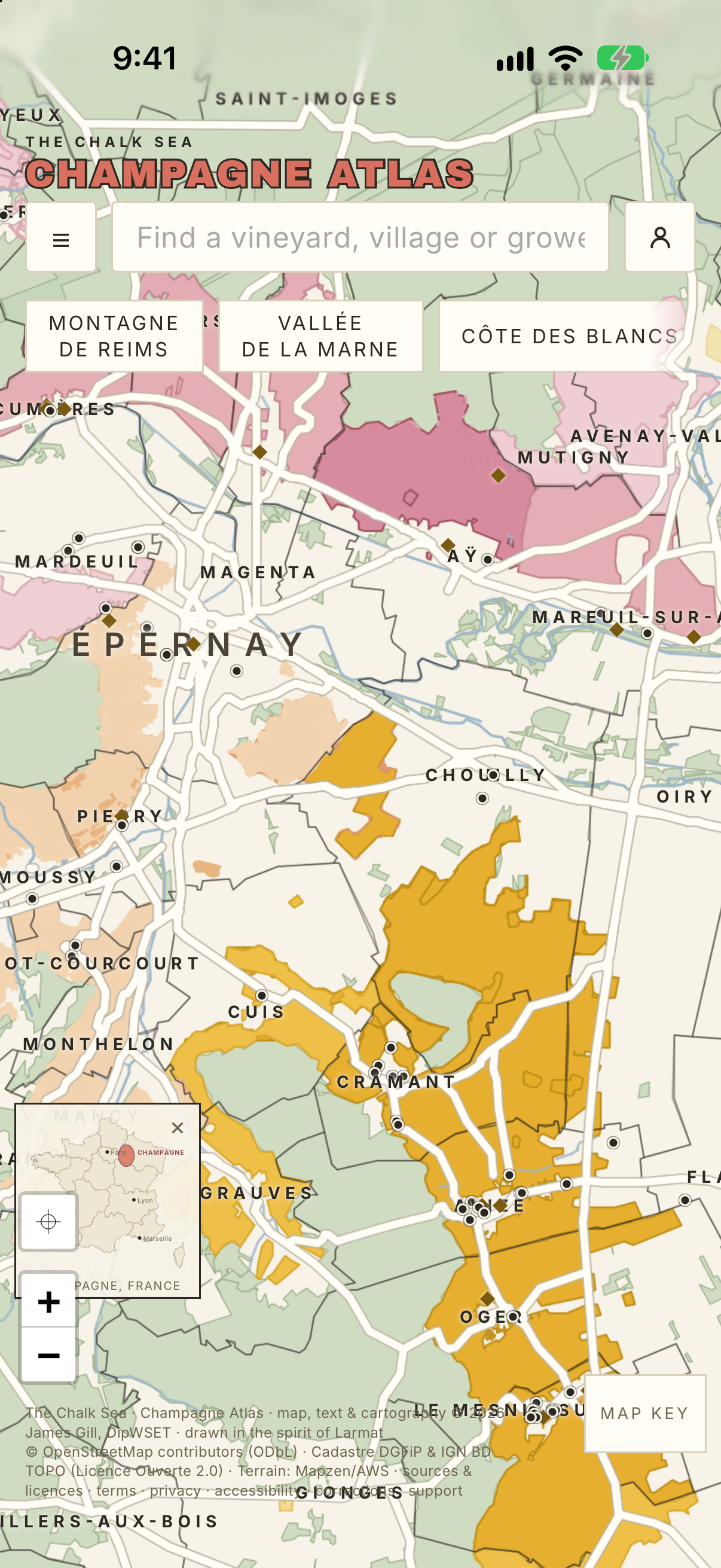
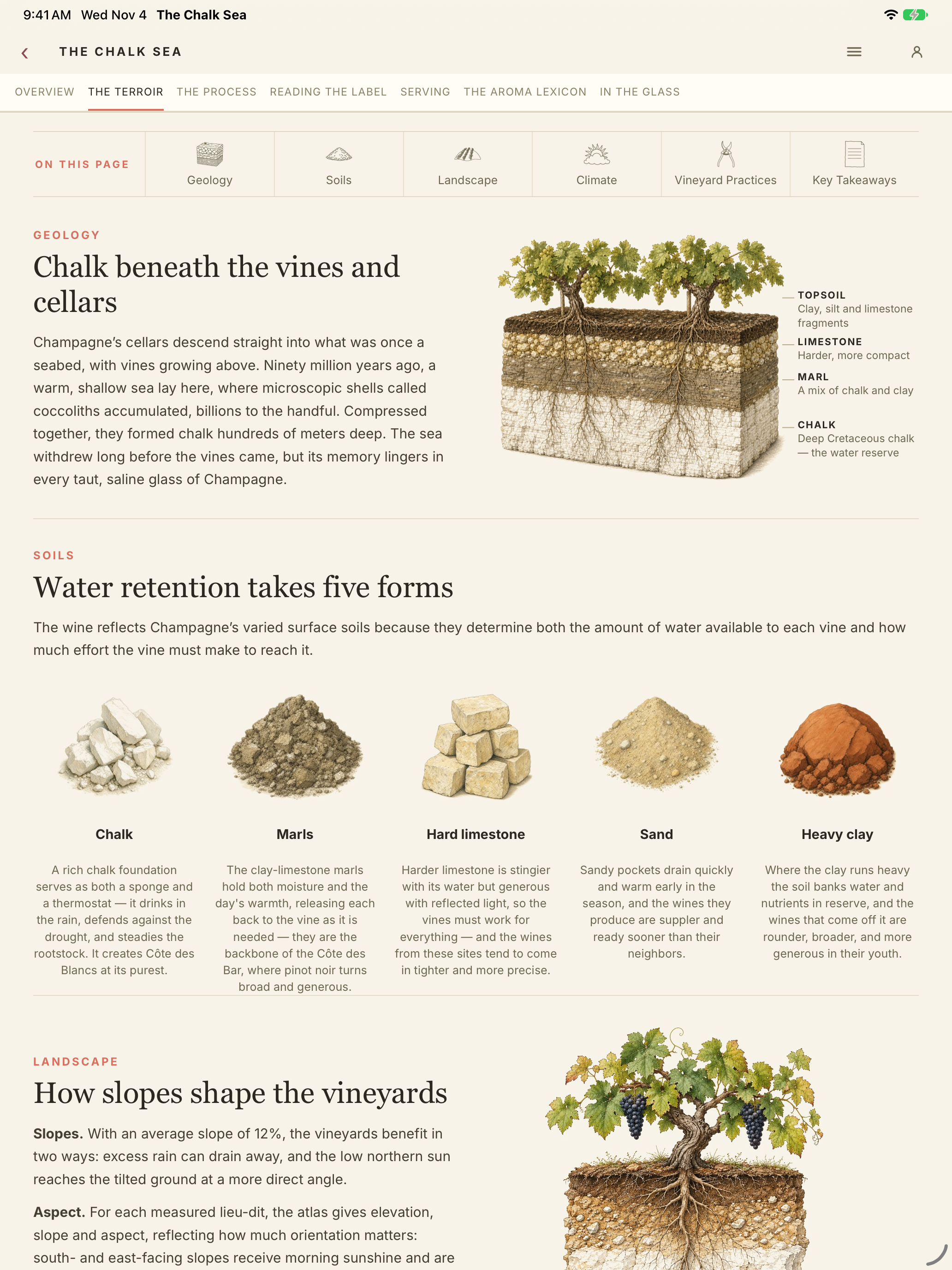
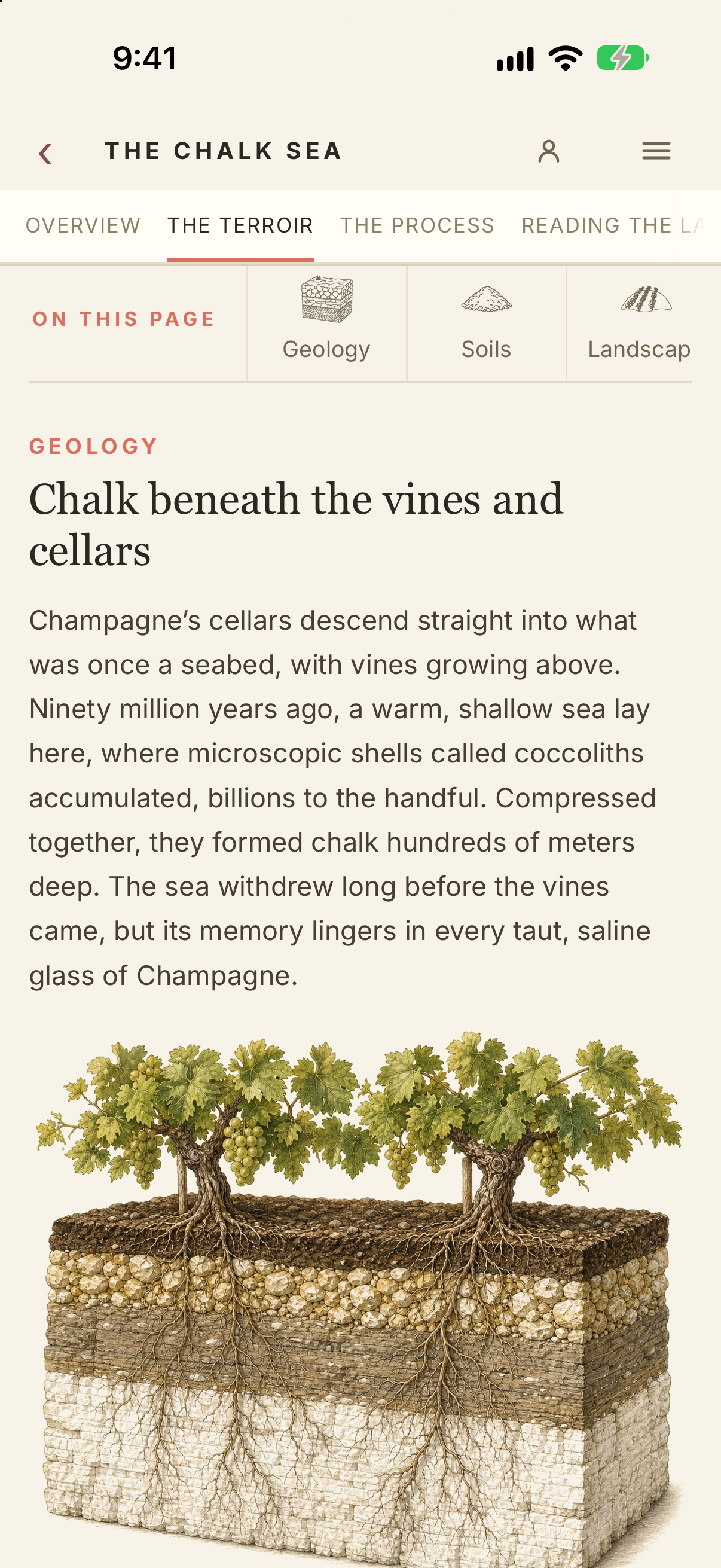
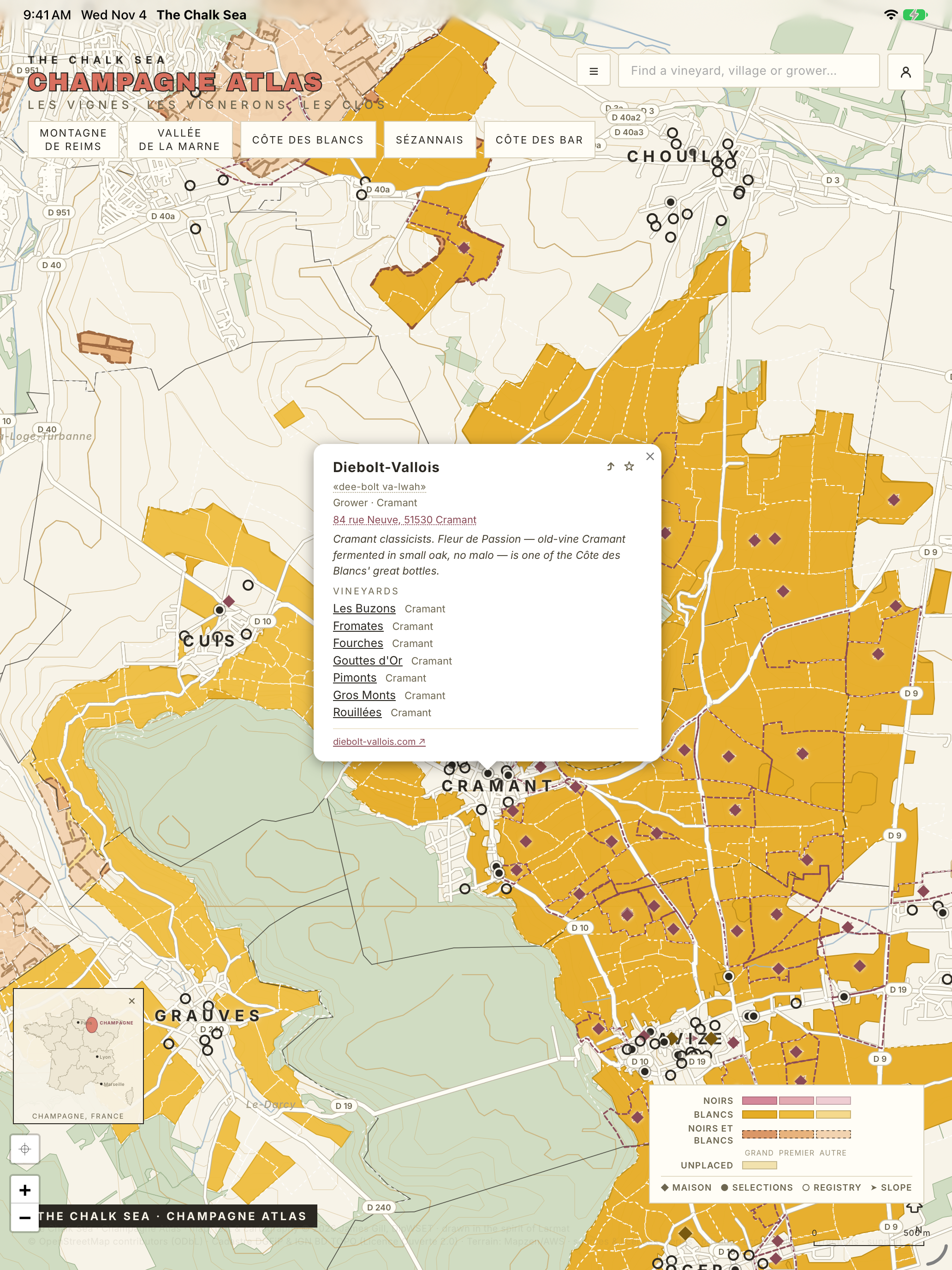
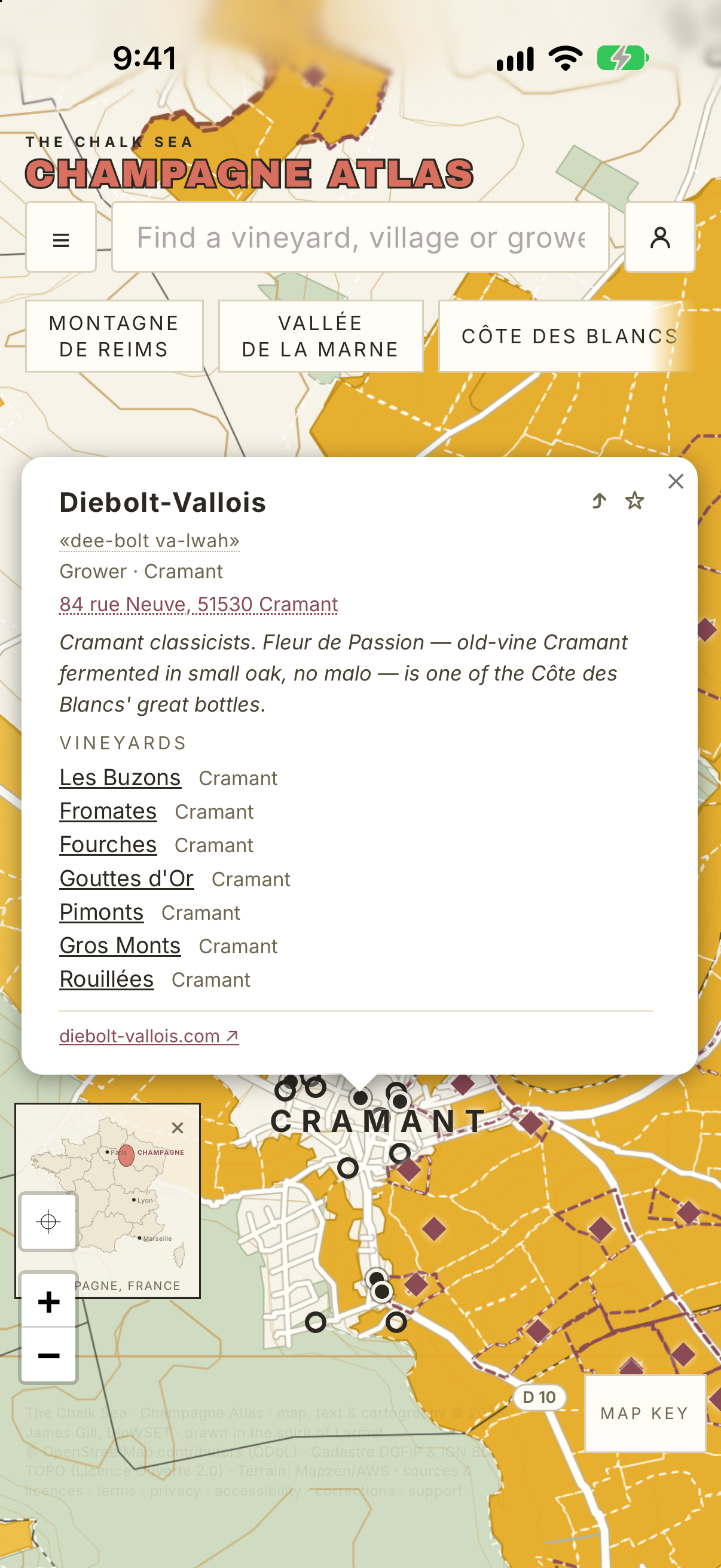


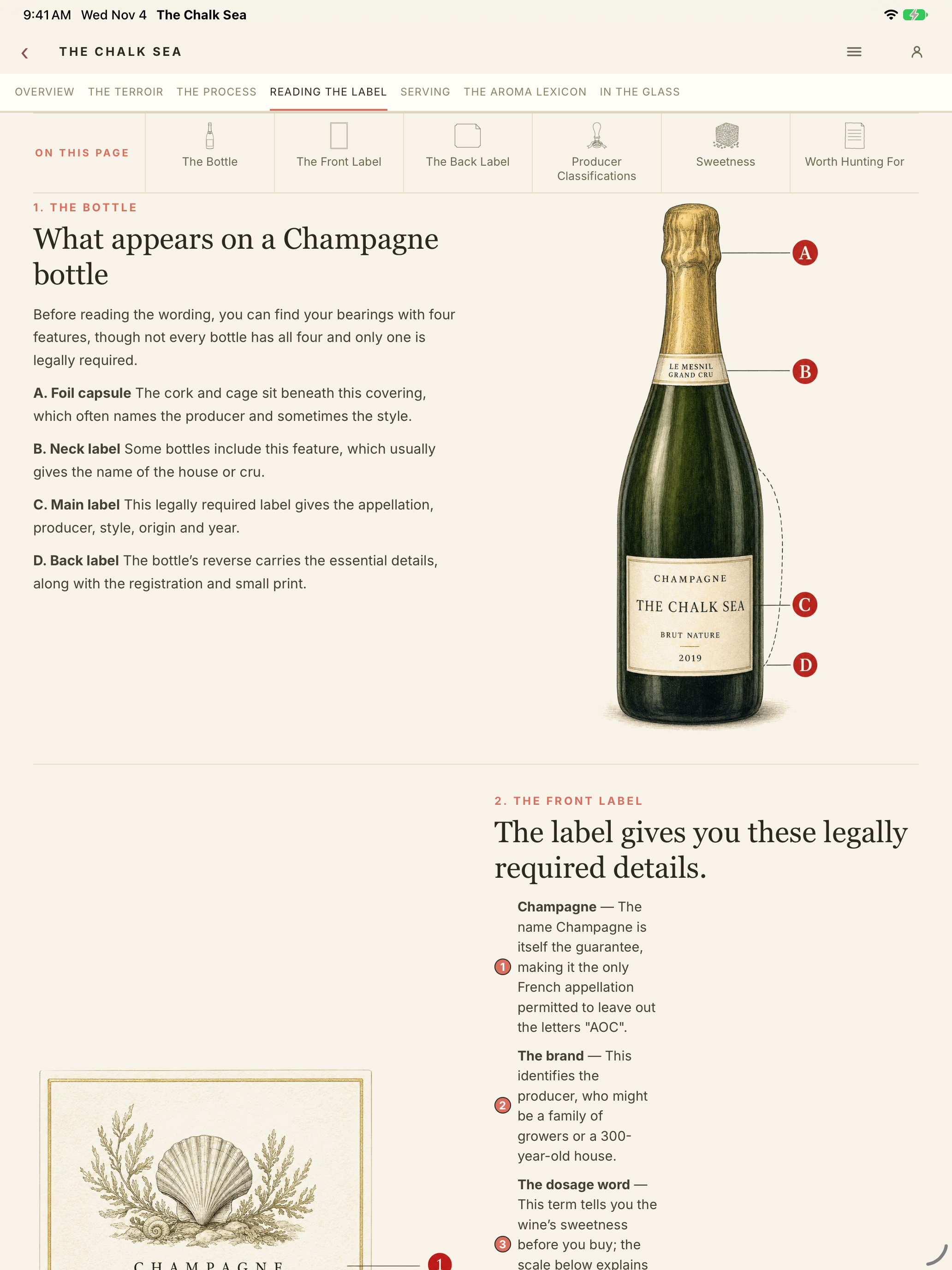
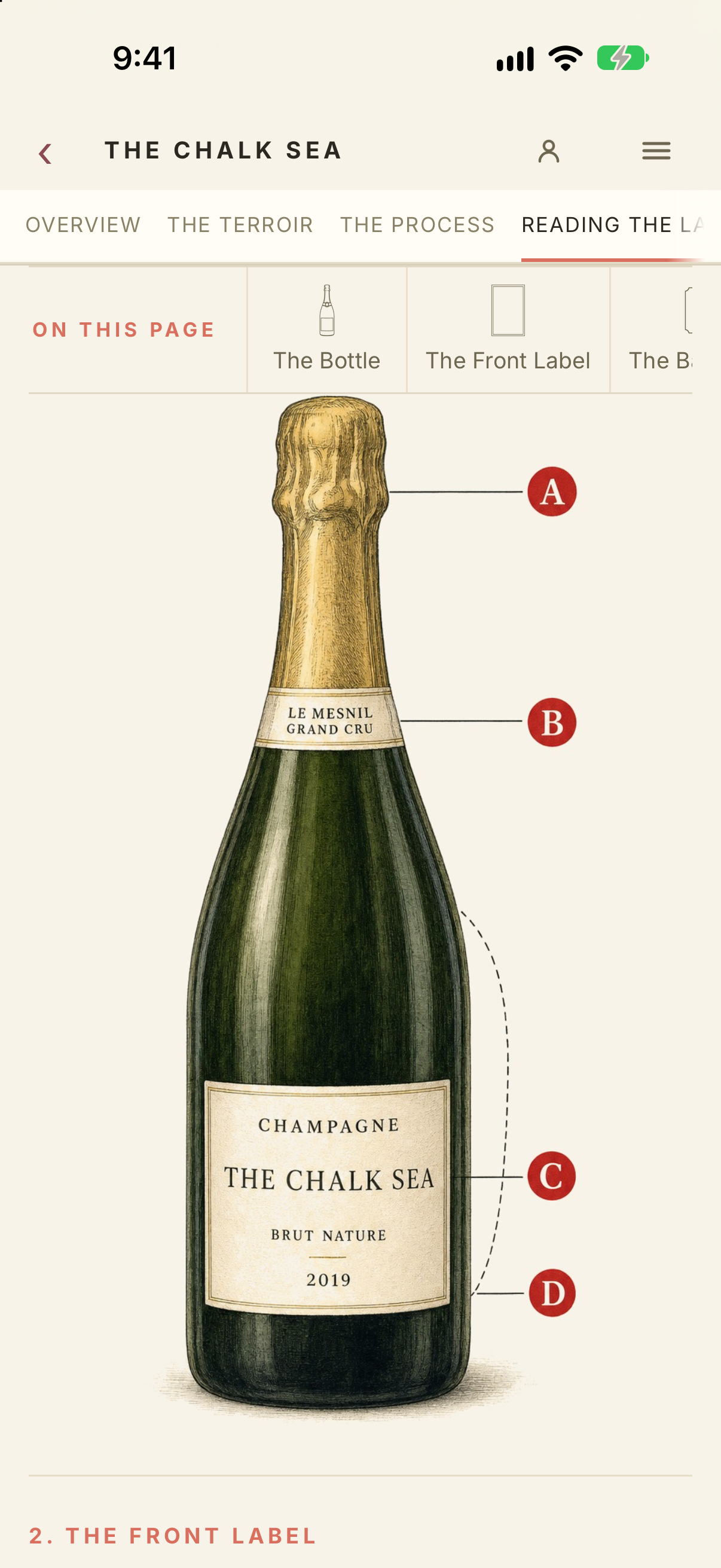


The iPad set is 2064×2752 and the iPhone set 1206×2622, both as shipped to the App Store. They carry the standard simulator status bar, as App Store screenshots do. If you need them without it, or at another size, or in a device frame, ask and I will send them the same day.
App icon — 1024×1024 PNG.
Using any of this
Everything on this page may be reproduced. Maps and cartography are © James Gill — please credit The Chalk Sea and, where there is room, link to thechalksea.com. The underlying vineyard boundaries come from French open data, credited in full on our sources page.
Anything you need that is not here — a different crop, a portrait, a higher resolution, a fact checked — write to info@thechalksea.com and you will have it the same day.
If you would like to try it
Tell me and I will send you a membership key, no questions and no expiry. You cannot write honestly about something you have only seen in screenshots, and I would rather you had the whole thing in front of you.
Start with the map, or read the story behind it, how to pick a great Champagne, or the reference library.